Henrico's stinging-insect calendar is predictable. Fertilized queens come out of hiding in April, build a nest the size of a golf ball through May, and go unnoticed until July. By late August the colony is at full…
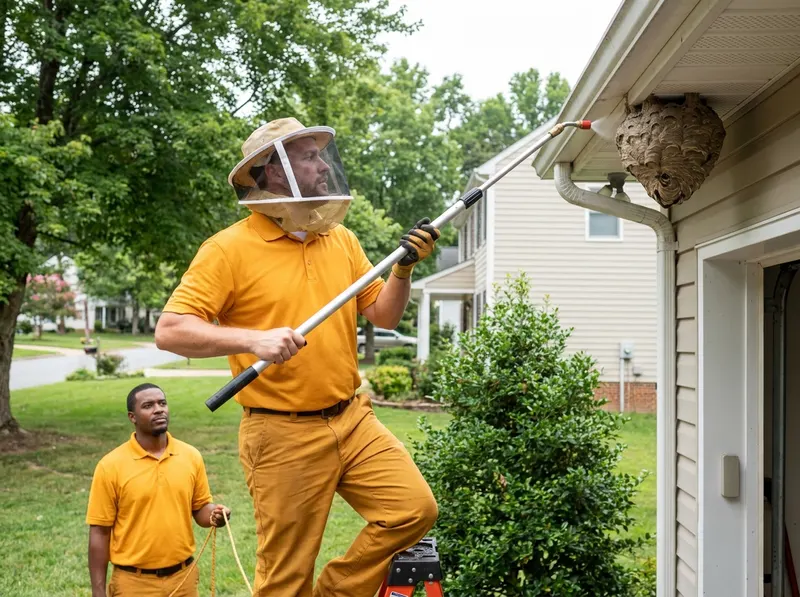
Henrico's stinging-insect calendar is predictable. Fertilized queens come out of hiding in April, build a nest the size of a golf ball through May, and go unnoticed until July. By late August the colony is at full population and switching from hunting insects to hunting sugar, which is exactly when homeowners in Glen Allen and Lakeside call because wasps are working the deck table and the recycling bin. That late-summer window is also when a nest is largest and most defensive, and it is the wrong time to poke at one from a stepladder. A hard frost eventually ends the colony — usually sometime in November here — but nobody should spend September avoiding their own back door waiting on the weather.
Where the nest sits decides most of the price. Paper wasps hang open, umbrella-shaped combs under deck rails, porch ceilings, and grill lids — common on the wood decks behind Twin Hickory and Wyndham homes, and generally a straightforward removal. Bald-faced hornets build the gray, football-shaped aerial nest in mature oaks and hollies, and the tall canopy over older Tuckahoe and Gayton lots often puts that nest twenty feet up, which means ladder work and a controlled takedown instead of a quick knockdown. Yellowjackets are the difficult ones: they nest in ground voids along mulched beds and fence lines in Varina, and they get into structures behind vinyl J-channel, through wood soffit gaps on Highland Springs and Sandston frame houses, and around loose brick weep holes. A yellowjacket colony inside a wall cavity cannot be fixed by sealing the hole — trapped workers chew inward toward drywall and light. Void colonies are treated at the entrance so foragers carry material through the nest, then the entry is closed only after activity stops.
One trade-off worth stating plainly. A one-time nest removal is enough for most Henrico homes, especially a single paper wasp nest on a porch, and there is no reason to sign up for anything ongoing. Recurring service earns its keep in a narrower set of cases: houses with repeated soffit and ridge-vent nesting year after year, small landlords managing several units in Laurel or Sandston who need spring nest-prevention on eaves before tenants complain, and properties near open ground where yellowjacket queens keep finding the same voids. That is a separate decision and gets quoted separately — nothing about the removal visit obligates you to it.
One clarification we make constantly, because it saves people money: a mud dauber builds a hard, tube-shaped mud nest on siding and in garages, is a solitary wasp, and rarely stings. Those mud tubes on a foundation wall are not termite mud tubes, and they are not a reason to panic. If a technician can settle that in five minutes on your carport in Innsbrook or Short Pump, you have learned something about your house instead of buying a treatment you didn't need. And if anyone in the household has a known sting allergy, say so when you call — nobody should be spraying a nest from a garden hose or a can while standing on a chair, and that risk changes how the visit is scheduled and staged.
Every job gets a firm, written price after a free on-site visit.
Tell us about your wasp and hornet nest removal job in Henrico and we'll send a clear, written quote — usually the same day.
 Vantora Pest Control Service