Henrico's mosquito problem is mostly the Asian tiger mosquito, and that changes the whole approach. It bites in the middle of the afternoon, it stays close to where it hatched, and it breeds in containers rather than…
Henrico's mosquito problem is mostly the Asian tiger mosquito, and that changes the whole approach. It bites in the middle of the afternoon, it stays close to where it hatched, and it breeds in containers rather than marshes — a corrugated downspout extension, a clogged gutter, the saucer under a potted fern, a tarp folded over firewood, a kid's wagon left upright after a thunderstorm. A tablespoon of water is enough. That is why so many homeowners in Tuckahoe, Lakeside, and Gayton get bitten worst in their own back corner and barely notice mosquitoes a block away. The single highest-value step in Henrico mosquito control is finding and emptying the breeding water on your own lot, because the mosquitoes biting you were almost certainly born there.
The geography matters too. Older neighborhoods with mature oak canopy — Lakeside, parts of Tuckahoe near the Deep Run corridor, the wooded lots off Gayton Road — hold humidity and shade all day, which is exactly what resting adults need. Newer subdivisions in Short Pump, Twin Hickory, and Wyndham back up to stormwater retention ponds and drainage swales; those ponds usually hold fish and predators, but the ditch that feeds them and the bordering ivy beds are prime harborage. In Varina, Sandston, and Highland Springs, low bottomland and roadside ditches near the James River flats stay wet for days after a storm, and yards near Dorey Park or Three Lakes Park sit against a permanent tree line. Around Innsbrook and Glen Allen, we most often find the source in irrigation boxes, tarped boats, and blocked gutters on two-story homes nobody has cleaned in three seasons. Season in Central Virginia generally runs from April into October, with the worst stretch during the humid weeks of July and August, and it ends with the first hard frost.
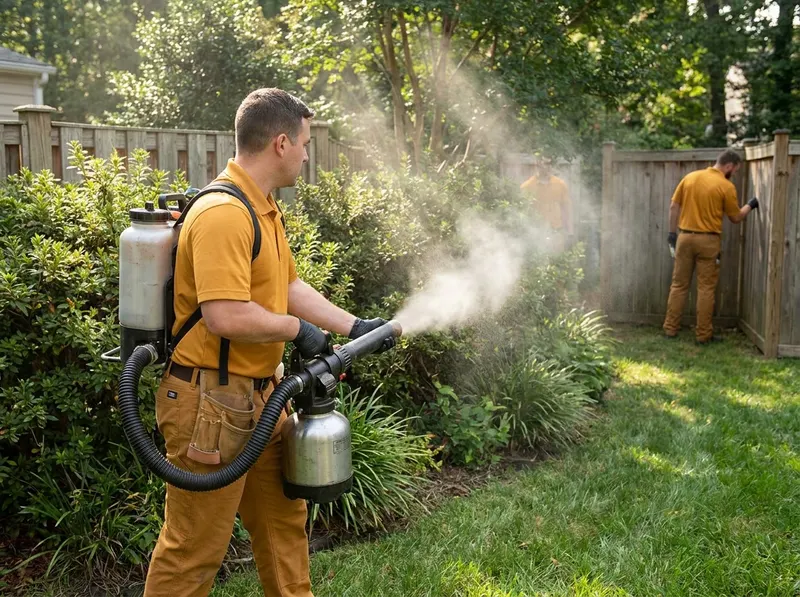
Here is the honest trade-off between one-time and ongoing. A single barrier treatment is the right choice when you have a dated reason for it — a graduation party, a wedding in the backyard, a stretch of family visiting. Residual product on foliage breaks down under UV and washes off in heavy rain, so a one-time application realistically holds a few weeks in Henrico's summer weather, less if you get a run of afternoon thunderstorms. If you want a usable yard from May through September, a recurring in-season program with visits roughly every three weeks is what actually delivers that, because it re-establishes the barrier after each rain cycle and lets us re-check the water sources each visit. Neither option requires a year-round contract, and we quote them side by side so you can pick the one that fits.
We also tell people when treatment is not the answer. If a neighbor's above-ground pool has been sitting green since last fall, or a shared county ditch behind the property line stays wet, your yard treatment will help but will not solve it — and for standing water on public land, Henrico County can be notified. Saying that out loud costs us a sale sometimes. It beats treating your yard four times while the source sits forty feet away. Ask for the product label and the applicator's Virginia credentials at the visit; any company working in Henrico should hand both over without hesitation. Call (686) 207-2404 and we'll come look at the yard first.
Every job gets a firm, written price after a free on-site visit.
Tell us about your mosquito control job in Henrico and we'll send a clear, written quote — usually the same day.
 Vantora Pest Control Service