Two things decide your termite treatment in Henrico County, and neither one is the bug: your foundation type and how much of the perimeter can actually be trenched. Older housing stock in Lakeside, Highland Springs,…
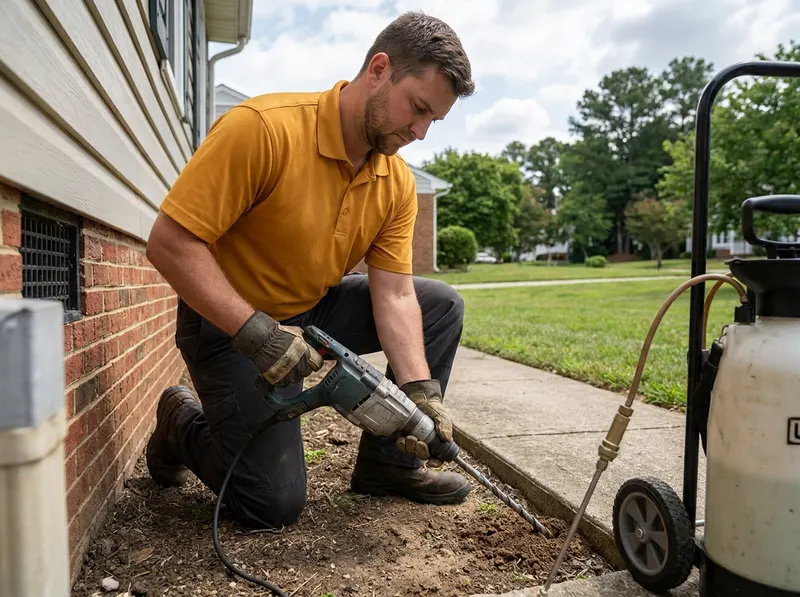
Two things decide your termite treatment in Henrico County, and neither one is the bug: your foundation type and how much of the perimeter can actually be trenched. Older housing stock in Lakeside, Highland Springs, Sandston, and Varina tends to sit on crawlspaces with block piers and wood sill plates — mud tubes there are visible from the access hatch, and a trench-and-treat around the exterior plus interior pier treatment usually handles it. Newer construction in Short Pump, Twin Hickory, Wyndham, and Gayton is more often slab-on-grade with brick veneer, which means drilling through the slab expansion joint or through mortar joints at 12-inch intervals to get termiticide under the concrete. Same insect, very different day of work, and that difference is most of the price spread.
Liquid barrier versus bait stations comes down to the yard, not the sales pitch. A non-repellent liquid termiticide applied in a continuous trench along the foundation gives you fast interception — foraging workers pick it up and it moves through the colony within weeks. It needs a diggable, uninterrupted perimeter, so patios, pool decks, dense foundation plantings, and wells complicate it. In-ground bait stations installed every 10–20 feet around the drip line are the better fit when there's too much hardscape to trench, when a homeowner would rather not drill a finished slab, or on the low, wet lots you see toward the James River floodplain in Varina where soil saturation works against a liquid barrier holding position. The honest trade-off: bait is slower — colony elimination is measured in months, not weeks — but it keeps monitoring in place and tells you if a new colony shows up. Liquid is faster and cheaper up front but is a treated zone, not a warning system.
Spot treatment is legitimate in a narrow case: a single infested pier, one garage sill, or a shed with obvious localized activity and no evidence anywhere else. Subterranean colonies forage well over 100 feet from the nest, so treating only where you saw the mud tube leaves the rest of the perimeter open. If the inspection finds activity at two or more separated points, a full perimeter treatment is the recommendation, and we'll show you the photos that led to it rather than asking you to take it on faith.
Swarm season in Central Virginia lands on warm afternoons from roughly March into May, often the day after rain — dark-winged swarmers piling up at a Glen Allen sunroom window or discarded wings on a Tuckahoe windowsill are the most common first sign homeowners call about. Springtime swarms near wooded lots off Deep Run Park or Three Lakes Park are normal for the area; termites indoors are not, and the two look nearly identical to most people, which is why identification comes before any quote. Also worth naming plainly: heavy mulch stacked against siding, a downspout dumping at the foundation, and crawlspace wood at high moisture content are the three conditions we find over and over in Henrico, and no treatment holds up well if they're left alone. We write those down as corrections you can make yourself. Virginia requires businesses applying termiticides to be licensed through the state — ask us for our credentials on the inspection visit, and ask anyone else the same question. If structural repair to a joist or sill is needed, we document it and refer it out; we do not perform carpentry, and we'll say so up front rather than pad an estimate.
Every job gets a firm, written price after a free on-site visit.
Tell us about your termite treatment job in Henrico and we'll send a clear, written quote — usually the same day.
 Vantora Pest Control Service