Henrico's housing stock fails in two predictable places, and both are on the far side of a door most homeowners never open. In the older ranches and Cape Cods around Lakeside, Laurel and Highland Springs, the weak…
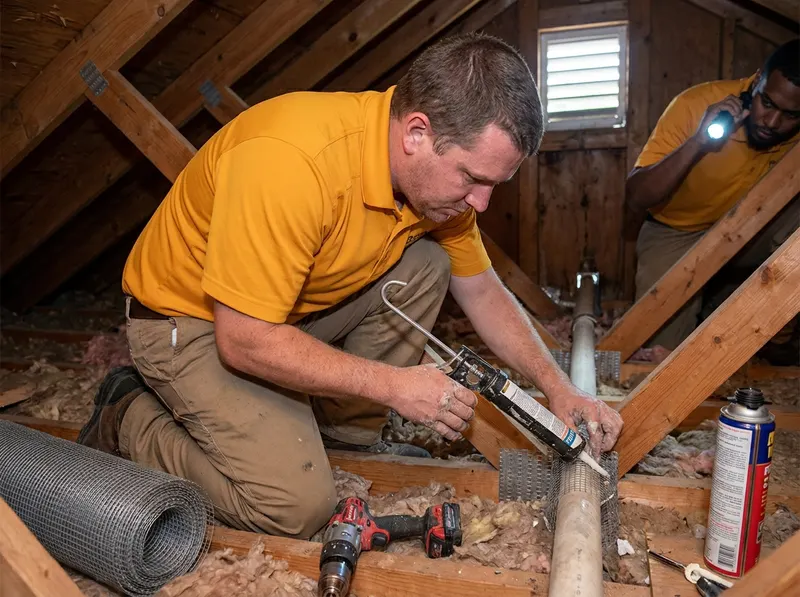
Henrico's housing stock fails in two predictable places, and both are on the far side of a door most homeowners never open. In the older ranches and Cape Cods around Lakeside, Laurel and Highland Springs, the weak points are at ground level: block foundation vents with corroded screens, a plywood crawl access door that has swelled and rotted at the bottom corner, and the gap where the sill plate meets brick. A house mouse needs about a quarter inch. In the 1990s-and-newer two-story homes through Short Pump, Twin Hickory, Wyndham, Gayton and the Glen Allen neighborhoods near Deep Run Park, the failures are up high instead — open soffit returns above the garage, gable vent screens chewed at the corner, and the joint where a lower roof ties into a wall. Mature oak canopy shading those streets gives gray squirrels a runway straight to the fascia. Out toward Varina and Sandston, detached garages, sheds and older farmhouse crawlspaces on partial block are the usual entry route.
We inspect before we quote because the count of openings is the price, not the square footage of your house. A crawlspace with three vents and a bad door is a different job from an attic where the soffit is open along 40 feet of eave. You get told which openings we found, where they are, and which ones we can seal versus which ones need a carpenter first — rotted fascia and failed roof decking are repairs, not exclusion, and we will say so instead of caulking over them.
Exclusion versus trapping-only is the real decision. If you caught one mouse in a Tuckahoe kitchen in October and there is no droppings trail in the crawlspace, snap traps and a single sealed penetration may be all you need. If you are hearing scratching overhead at night, finding droppings on attic insulation, or this is the second or third time a company has treated the same problem, bait and traps alone will not hold — the animals are following a structural opening that is still there. The trade-off is honest: exclusion costs more up front than a service call, and it is one-time work rather than a recurring bill. Trapping is cheaper this month and often repeats every winter. Sequence matters too — we trap out active rodents before closing the last opening, because sealing animals inside an attic creates a worse problem than the one you called about.
Timing: the push indoors across Central Virginia runs hardest from late September through December as nights drop, and again in late winter when squirrels look for nesting space. Sealing in spring or summer is easier work and cheaper for you, since we are not competing with an active population. If you are selling and a home inspector flagged rodent evidence in the crawlspace, tell us the closing date when you call — that changes how we schedule. One-time exclusion and ongoing pest service are separate purchases here; you do not have to sign a quarterly agreement to have your attic sealed.
Every job gets a firm, written price after a free on-site visit.
Tell us about your attic and crawlspace rodent exclusion job in Henrico and we'll send a clear, written quote — usually the same day.
 Vantora Pest Control Service