The trade-off worth understanding before anybody sprays: a contact spray along a visible ant trail kills foragers in seconds and looks like a win, but with odorous house ants it can trigger budding — the colony splits…
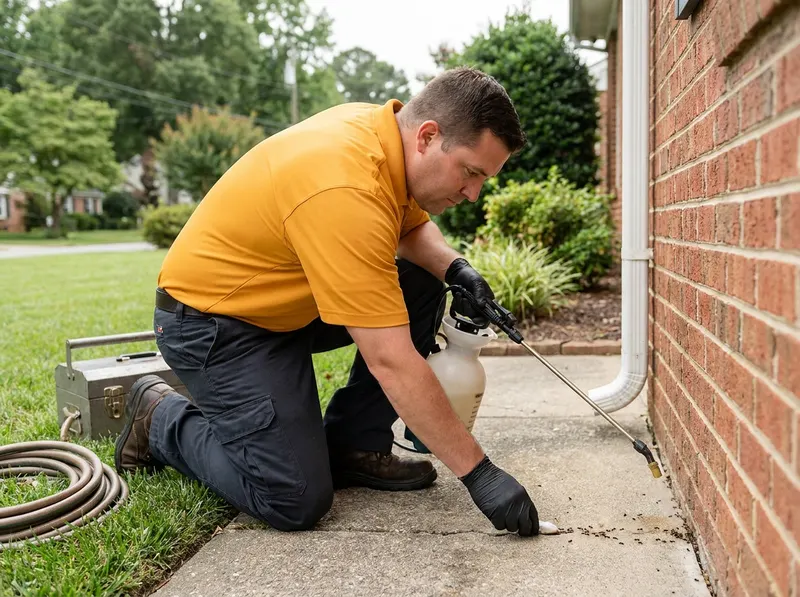
The trade-off worth understanding before anybody sprays: a contact spray along a visible ant trail kills foragers in seconds and looks like a win, but with odorous house ants it can trigger budding — the colony splits and relocates deeper into the wall void, and you see ants again in three weeks two rooms away. That is the exact experience behind most "I already paid someone for this" calls we get from Henrico homeowners. Baiting works slower and lasts longer, because workers carry the active ingredient back to the queen and the brood. Expect to still see ants for five to ten days after a bait-first treatment. That is the bait doing its job, not a failed visit.
Where the ants come from depends on which part of the county you live in. In Short Pump, Twin Hickory, Wyndham, and Gayton, newer slab-and-mulch construction with irrigated beds pushed tight against the foundation gives odorous house ants a straight path under the sill; the trail usually shows up at a dishwasher line or a kitchen window. In Lakeside, Laurel, and Tuckahoe, older homes under mature oaks and shaded crawlspaces are where carpenter ants matter — they want wood that has already been softened by water, so a leaking gutter return, a rotted crawlspace sill plate, or a deck ledger board is the real target. In Varina, Sandston, and Highland Springs, heavier clay soils and creek-bottom drainage near the airport corridor mean pavement ants nesting under driveway slabs, patio pavers, and front-walk expansion joints, then coming up through the joint indoors. Around Innsbrook and Glen Allen, we see both patterns depending on the age of the block.
Season drives the volume. Central Virginia ants get moving with the first warm rains in March and April — flooded nests send foragers up and inside — and carpenter ant swarmers show up indoors from April into June, often mistaken for termite swarmers. Winged ants have a pinched waist and unequal wing lengths; termite swarmers do not. If you are not sure which you found, save two in a plastic bag and we will tell you at the inspection, because the answer changes the entire scope of work. Ants near mulch and mature landscaping — the kind of planting you see around Deep Run Park or the beds at Lewis Ginter Botanical Garden — are normal outdoors and only become a service call when the trail crosses the threshold.
When one-time treatment fits: a single defined trail, one or two rooms, no history of repeat activity, no soft wood. When ongoing quarterly protection fits better: a home that has had ants back three springs running, a crawlspace with standing moisture, or a rental you cannot get inside on short notice. Ongoing service is a maintenance choice, not a requirement, and we quote it as a separate line so you can decline it and still get treated. On licensing — ask on the phone and we will tell you exactly what credentials the technician applying product in your home carries, before he opens a truck door. Henrico is its own county with its own housing stock and its own soil, adjoining Richmond city but not part of it, and the ant pressure here behaves accordingly.
Every job gets a firm, written price after a free on-site visit.
Tell us about your ant control job in Henrico and we'll send a clear, written quote — usually the same day.
 Vantora Pest Control Service